
Reviewed 10 November 2026 · By Project Glow Editorial · Evidence-informed reading
A watery toner, a milky fluid and a cream can look like three different jobs. On a crowded shelf, they may overlap. Understanding the formula helps more than counting steps.
What makes a toner look milky?
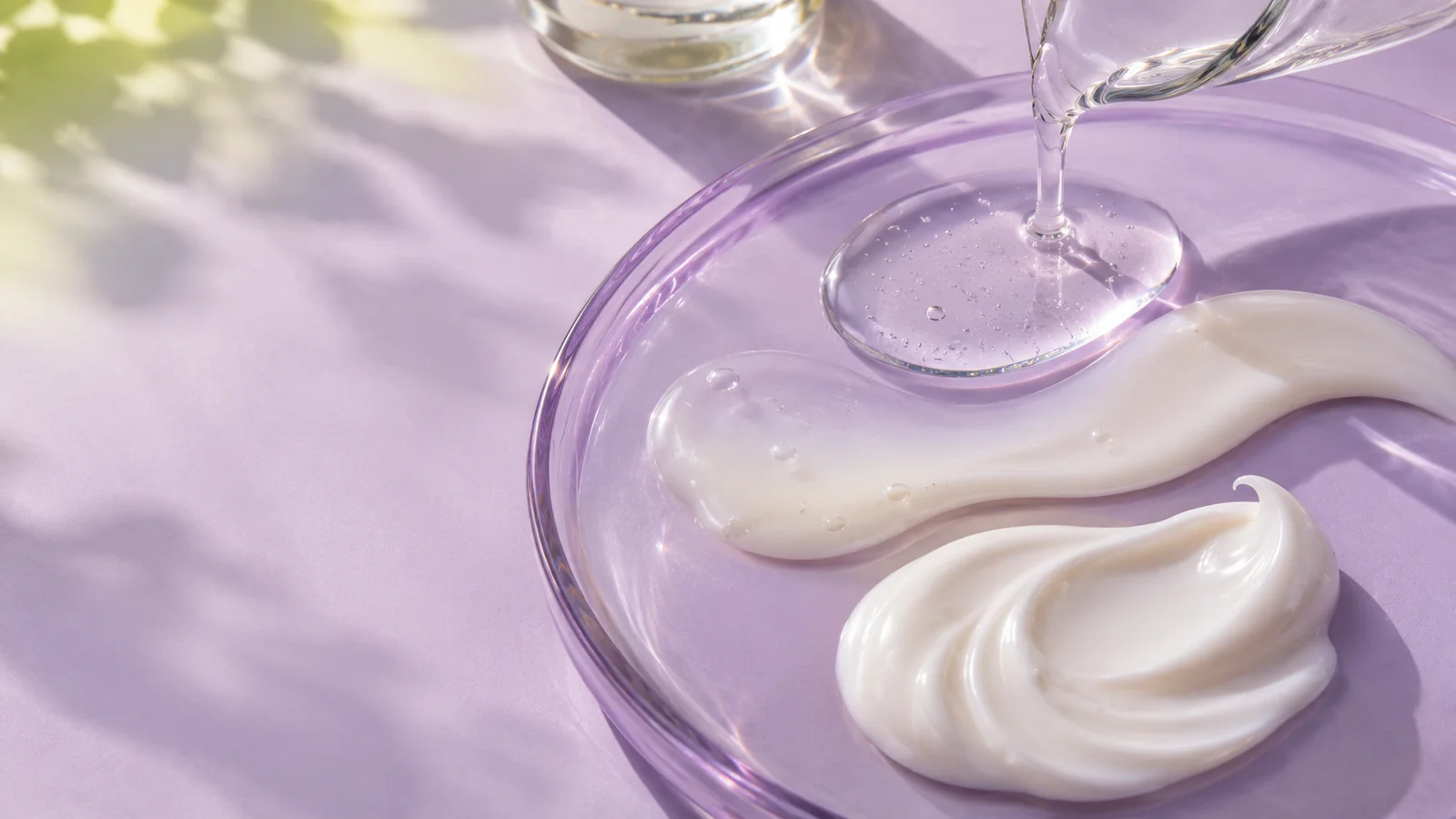
Many skincare fluids contain both water-loving and oil-loving ingredients. An emulsion distributes one phase as tiny droplets in another with help from emulsifiers. That can create a white or cloudy appearance and a softer, more lotion-like glide than a clear watery product. But a visual impression cannot identify the exact structure or proportions in a particular bottle. [3][4]
Three common ingredient jobs help explain feel:
Ingredient role: Humectant; Examples: Glycerin, hyaluronic acid, urea; What it usually contributes: Helps the outer skin layer hold water. [1]
Ingredient role: Emollient; Examples: Some oils, esters, silicones; What it usually contributes: Adds slip and a smoother feel. [1]
Ingredient role: Occlusive; Examples: Petrolatum, some waxes and silicones; What it usually contributes: Helps reduce water loss at the surface. [1]
A product can combine these roles. The amount, mix and full formulation matter; an ingredient list alone does not reveal a finished product's performance. In a 2024 laboratory formulation study, changing the emollient altered droplet properties and other measured behaviour in model creams. That shows why swapping one ingredient can change a product, but it does not rank retail milky toners. [4]
Is a milky toner a microemulsion?
Not necessarily. “Microemulsion” is a technical description of a particular oil–water–surfactant system, not a synonym for “lightweight” or “milky.” Scientific references describe microemulsions as thermodynamically stable and commonly transparent, with structure determined by the whole system. A cloudy product marketed as a milky toner cannot be identified as a microemulsion by sight, and a small droplet size is not proof of better hydration or deeper delivery from an unknown retail formula. [5]
Droplet size can matter to a formulator's stability, spread and delivery design. It is only one property alongside the chosen ingredients, their amounts, viscosity, packaging and how the formula changes after application. In a study of five experimental creams, water loss after application changed droplet size and other properties; humectants partly affected those changes. That was a formulation experiment, not evidence that any consumer “microemulsion” beats an ordinary moisturiser. [3]
Milky toner vs serum vs moisturiser
A toner is usually positioned after cleansing. A serum is usually presented as a concentrated treatment step. A moisturiser is chosen to support comfort and reduce dryness. These are useful shelf labels, but they are not fixed scientific categories. A milky toner may act like a very light moisturiser; a serum may contain mostly humectants; a fluid moisturiser may cover both jobs.
Ask what the formula supplies and what your routine lacks. If your skin feels comfortable with a gentle cleanse, moisturiser and sunscreen, there is no rule requiring a toner and serum as extra layers. The American Academy of Dermatology describes a simple cleansing, moisturising and sun-protection routine and cautions that too many products can irritate skin. [2]
If a watery product feels pleasant but you are still dry or tight soon afterwards, a moisturiser may be the more useful next step. If a rich cream feels too heavy, a lighter fluid can be a reasonable texture choice. Neither observation diagnoses a skin type; comfort and tolerance are practical guides. Persistent irritation, rash or painful dryness deserves advice from a qualified clinician.
A quick shelf check before buying
1. Name the job. Are you looking for comfort, a specific active ingredient or simply a texture you enjoy?
2. Read the whole pack. Compare the ingredient list, directions and any specific claim. Do not infer concentration from the product name.
3. Check what you already use. A moisturiser may provide humectants and softening ingredients without another step. [1]
4. Try one change at a time. Give yourself a chance to notice comfort or irritation without several new products competing for credit.
5. Keep sunscreen separate. A pleasant milky feel does not make a cosmetic fluid a tested sunscreen. Follow a sunscreen's own label and application directions.
The affordable routine guide can help you prioritise basics. Our sensitive-skin barrier guide covers what to do when too many layers feel uncomfortable.
Keep exploring
Frequently asked questions
Can a milky toner replace moisturiser?
For some people and formulas, a light fluid may provide enough comfort. For others, it will not. Check the actual ingredients and how your skin feels over time; the name alone cannot answer it. [1]
Is a serum always stronger than a toner?
No. “Serum” is a product category, not a standard concentration or proof of better results. Compare the finished products and their evidence.
Does “microemulsion” mean the product penetrates better?
It describes a formulation system. Delivery depends on the particular ingredients and formulation; it does not guarantee a useful result from every cosmetic product. [5]
Do I need all three steps?
No universal routine requires a toner, serum and moisturiser together. Start with cleansing, moisturising and sun protection, then add a product for a clear reason. [2]
Sources and further reading
- Skin 101: skin barrier physiology and moisturiser components, 2025
- American Academy of Dermatology: skin care on a budget
- Experimental study of changes in cream properties after topical application
- Experimental study of emollients in model dermatological creams
- Microemulsion microstructures: a tutorial review
Sources checked 2026-11-17. This article is general education, not a diagnosis or individual treatment plan. Ask a qualified clinician about persistent symptoms, pregnancy or medication questions.