
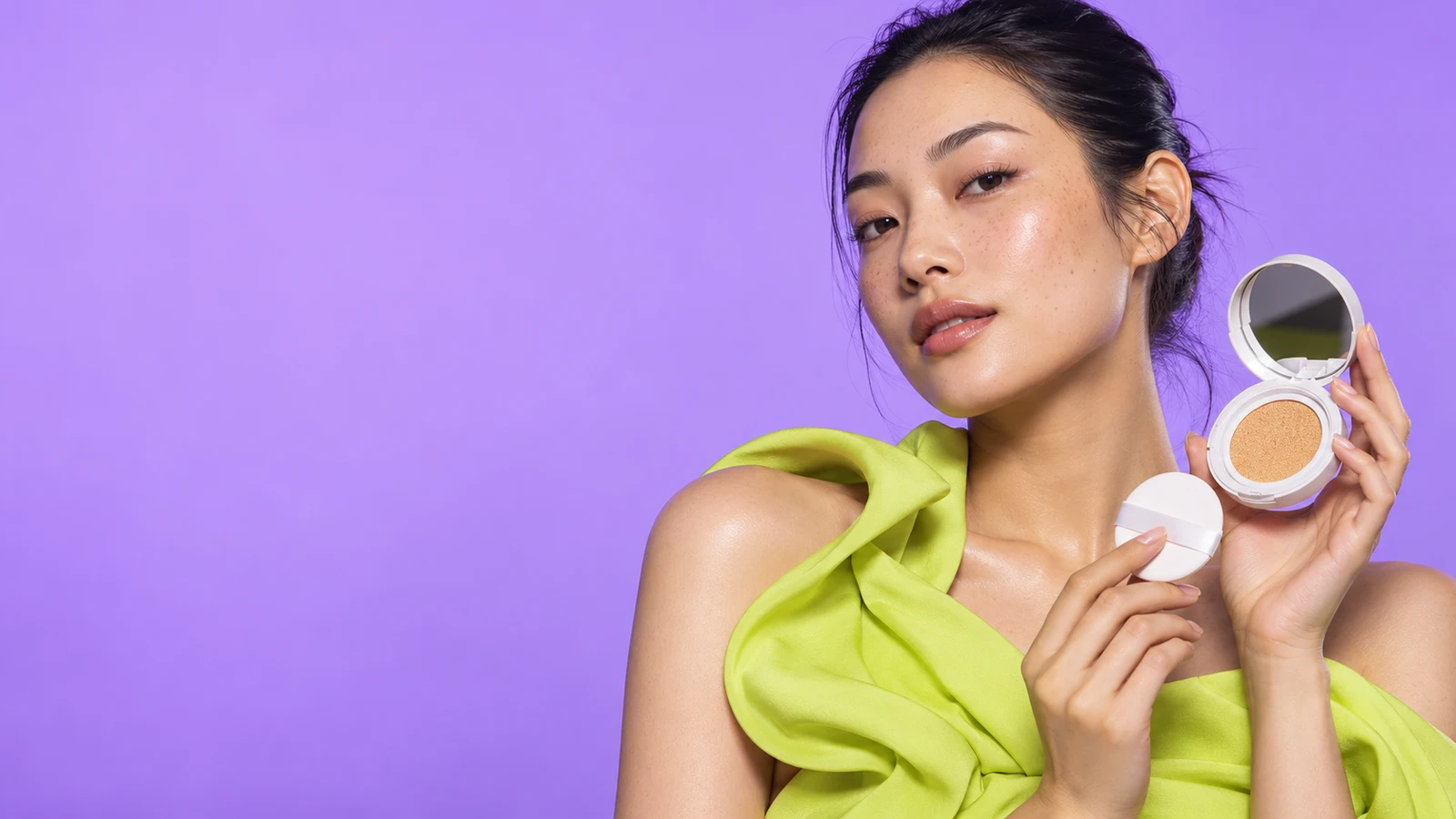
You pick up a cushion foundation for the finish. Then the box promises hydration, barrier care and a list of ingredients you recognise from your skincare shelf.
It sounds convenient. But how much does “skincare-infused” actually tell you?
In the second edition of Trending. Translated., we’re looking inside the compact: what the format does, what the label can explain and which questions are worth asking before you buy.
Why skincare and makeup are crossing over
This is a real category shift. In its 2026 outlook, published in December 2025, Olive Young highlighted “skincaring makeup” and reported that skincare-related searches within its makeup category had risen by more than 150% year on year. That included terms associated with soothing, barrier care and hydration. Those figures describe activity at one retailer in the preceding year, not a clinical result or a survey of every Gen Z shopper. [1]
The appeal makes sense: a base that looks good and feels comfortable is an attractive idea. The next step is understanding what the specific product is promising, rather than treating every hybrid formula as the same thing.
A cushion is a format, not a skincare category
A typical cushion foundation holds liquid base makeup in a compact, often in a soaked sponge or behind a mesh, and comes with a puff for application. The format makes it easy to carry and touch up. It doesn’t tell you whether the finish is matte or dewy, how much coverage you’ll get or what benefits have been tested.
Think of three separate questions: how does it look, how does it feel and what evidence supports any additional skincare claim? A nice finish can be a perfectly good reason to choose makeup. It doesn’t need to become a treatment to earn a place in your bag.
Read a real ingredient list
For a concrete example, LANEIGE’s Malaysian page for Neo Cushion The Matte lists niacinamide, panthenol, glycerin and sodium hyaluronate for shade 13C Cool Porcelain. It also lists ingredients such as dimethicone, colour pigments and fragrance. [2]
This shows how familiar skincare ingredients can sit within a makeup formula. It doesn’t establish their individual concentrations, how much each contributes or whether the product will suit you. We have not tested this cushion; it’s a label-reading example, not a recommendation.
Check the exact shade, version and market on the pack you’re buying. A brand’s overseas website is a useful reference, but it should not replace reading your own product’s label.
Translate the claim, not just the ingredient
“Hydrating finish”, “skin looks smoother” and “treats acne” are very different promises. One may describe the experience of wearing a product; another may imply an effect beyond appearance. In the US, a product’s intended use helps determine whether it is regulated as a cosmetic, a drug or both. Makeup with sunscreen claims is one example of a product that can fall into both categories. [3]
When a brand mentions testing, ask what was measured. Was it a wear test, a consumer questionnaire or a study measuring changes in skin? How long did it run, and was it testing this finished formula? Those answers help you understand the claim without dismissing the product or assuming it can do everything.
An ingredient list is useful, but it isn’t a recipe. Under US labelling rules, most ingredients are listed in descending order, with exceptions including ingredients at 1% or less and colour additives. You cannot reliably calculate an ingredient’s percentage or a product’s effectiveness from its position alone. Other markets have their own rules. [4]
What if the cushion has SPF?
An SPF number deserves attention, but it isn’t permission to ignore application. Johns Hopkins Medicine advises that sunscreen in makeup is not enough on its own because most people do not use enough makeup to get the labelled protection. [5]
Use a sunscreen that provides broad-spectrum protection, SPF 30 or higher and water resistance, following its directions. The American Academy of Dermatology advises reapplying approximately every two hours outdoors and after swimming or sweating as directed. A quick cushion touch-up should not automatically be treated as a complete sunscreen reapplication. [6]
A better cushion-shopping checklist
Start with the finish you enjoy. Consider coverage, shade, undertone and how it wears. A viral shade match on someone else is only a starting point.
Read the full formula. Check ingredients you already know you need to avoid. Don’t let one fashionable ingredient stand in for the whole product.
Ask what the claim means. Separate coverage and comfort from longer-term skincare outcomes. Look for evidence matching the exact formula and promise.
Look after the applicator. Use clean puffs or sponges, follow the product’s care instructions and avoid sharing makeup applied directly to skin. The AAD also recommends keeping cosmetics in a clean, dry space away from direct sunlight. [7]
Shopping overseas? Take the label with you
This is where Project Glow fits into the journey. You might find a cushion in Seoul, recognise the shade and love the packaging, but still struggle to understand the ingredients or directions.
Project Glow helps you explore product information, translate supported foreign-language labels and learn about ingredients. A translation can make the next question easier to ask. It cannot tell you your perfect shade or prove a formula will work for your skin.
Enjoy the makeup. Understand what’s inside. Let the claims earn your confidence.
Keep exploring
Frequently asked questions
What is a cushion foundation?
A cushion is a compact format for liquid base makeup, commonly using a soaked sponge or mesh and an application puff. The format alone does not establish skincare benefits.
Does skincare-infused makeup replace my skincare routine?
An ingredient mention does not establish that a makeup product performs every job in your routine. Look at your goal, the complete formula, the claim and any finished-product evidence.
Can I rely on the SPF in my cushion foundation?
Most people do not apply enough makeup to achieve the labelled sun protection. Follow sunscreen directions and use broad-spectrum SPF 30 or higher with water resistance, reapplying as directed.
Can the ingredient list tell me the percentage of niacinamide?
Usually not. Unless the brand discloses the concentration, the list alone does not reveal an exact percentage. US ingredient-order rules also contain exceptions.
Is the compact in the hero image a LANEIGE product?
No. The image is an AI-generated editorial photograph of an unbranded compact. LANEIGE appears only as a sourced ingredient-list example; Project Glow has not tested or endorsed that product.
Sources and further reading
- Olive Young’s 2026 trend outlook
- LANEIGE Malaysia: Neo Cushion The Matte ingredients
- FDA: Makeup
- FDA: Summary of Cosmetics Labeling Requirements
- Johns Hopkins Medicine: Sunscreen and Your Morning Routine
- AAD: Sunscreen FAQs
- AAD: When to toss your makeup and sunscreen
Sources checked 2026-10-27. This article is general education, not a diagnosis or individual treatment plan. Ask a qualified clinician about persistent symptoms, pregnancy or medication questions.